
This blog explores why smaller, accurate prospect lists can outperform massive B2B databases. From better email deliverability and segmentation to stronger personalisation and sales alignment, it examines why modern marketing teams are shifting from maximum reach to maximum relevance - and how live research, multi-source sourcing and a blend of automation, AI and human expertise can create more accurate, campaign-ready B2B contact data
For years, B2B marketing operated on a simple assumption: more is better. More contacts meant more reach. More reach meant more responses. And more responses, in theory, meant more pipeline. It made sense when outbound marketing was largely treated as a numbers game. Build the biggest database possible, send enough emails, and wait for a small percentage of prospects to convert.
But that volume-first model is becoming increasingly difficult to justify.
Inboxes are harder to reach. Buyers expect relevance. Marketing teams are under pressure to prove efficiency, not just activity. And every inaccurate contact creates work somewhere else – from bounced emails and wasted campaign spend to manual data cleaning and poor sales follow-up.
A database of 100,000 contacts may look impressive on a dashboard. But if a large proportion of those contacts are outdated, irrelevant, duplicated, poorly matched to the ideal customer profile (ICP), or difficult to activate, the number itself means very little.
Meanwhile, a smaller, accurate prospect list built around a specific campaign can often create far more value. The question is no longer: How many contacts do we have? It is: How many of these contacts are genuinely worth reaching?
Database size is an easy metric to understand - and an easy one to sell.
A B2B data provider offering millions of contacts sounds more powerful than one talking about a carefully researched target audience. A campaign reaching 50,000 prospects can appear more ambitious than one reaching 5,000.
But potential reach and actual relevance are not the same thing. A massive B2B database can still contain:
The database looks large. The usable audience may be much smaller. This is where volume creates an illusion of opportunity. Marketing teams start measuring how many people they could reach instead of how many people they should reach.
A better question is: Would we confidently spend time and budget trying to engage every person on this list?
If the answer is no, database size is probably the wrong measure of value.
Large databases are not inherently ineffective. The problem begins when access to a large volume of B2B contact data is mistaken for a targeting strategy. Most pre-built databases are designed for breadth. They need to serve thousands of customers across different industries, regions, products, and campaign objectives.
Your campaign is much more specific.
You may need procurement leaders within a particular type of manufacturing company. Marketing operations professionals working within a specific technology environment. Regional decision-makers inside complex global organisations. Or contacts who fit a combination of criteria that cannot be captured by industry, company size, and job title alone.
The broader the database, the easier it is to find contacts who technically match a filter. The harder question is whether they actually belong in your campaign.
One of the biggest problems with high-volume prospecting is false relevance. A contact can match every visible filter and still be the wrong person.
Take job titles. A “Head of Marketing” at a 100-person technology company may own demand generation, CRM, marketing data, content, and operations. The same title at a global enterprise may have a much narrower remit.
On paper, both contacts match. In reality, only one may be relevant to your offer.
The same problem appears across industries, geographies, company structures, and seniority levels. Broad filters are useful for narrowing a market, but they rarely provide enough context to determine genuine buying relevance. When thousands of contacts are added to a campaign simply because they meet surface-level criteria, the prospect list grows faster than its quality. Smaller, more accurate prospect lists create a different standard:
Every contact should have a clear reason to be there.
B2B contact data changes constantly. People move companies. Responsibilities shift. Teams are restructured. Businesses merge. Domains change. New decision-makers appear while old contacts remain in databases and CRMs.
Some of these changes create obvious problems. An email bounces. A sales representative discovers that a prospect left the company months ago. Other problems are much harder to spot. The email still delivers, but the recipient no longer owns the relevant area. The job title is technically correct, but the scope of the role has changed. The company still exists, but it no longer fits the original campaign criteria.
These records do not always trigger a visible error. They simply underperform. That makes stale prospect data particularly expensive. Marketing teams may blame the message, the offer, or the channel when the real problem started with the audience. Researching and validating a prospect list closer to the point of activation helps reduce that uncertainty.
When a B2B campaign underperforms, the instinct is often to increase volume. Low response rate? Add more contacts. Pipeline slowing down? Expand the audience.
Not enough engagement? Launch another sequence. But more outreach cannot fix a targeting problem.
If the original audience was too broad, adding more contacts simply scales the mismatch. More emails are sent to people who were unlikely to engage. More budget is spent on weak-fit prospects. More leads are passed to sales that require manual qualification.
Activity increases. Efficiency does not. Smaller prospect lists make targeting quality more visible. When every contact has been selected for a reason, teams are more likely to examine the audience before increasing the volume.
These questions slow prospecting down at the right stage - before poor data becomes expensive campaign activity.
The difference is not simply one of size. It is a difference in how the data is sourced, selected, and prepared for use.
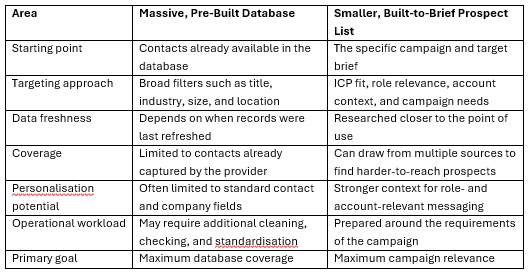
A large database may give a team more contacts to choose from.
A built-to-brief list is designed to reduce the number of contacts the team needs to question.
That distinction matters.
A smaller list is not automatically a better list. A list of 500 poorly selected contacts is still a poor list. The advantage comes from accuracy, relevance, and campaign fit.
The account is right.
The company genuinely matches the campaign’s ICP and targeting criteria.
The person is right.
The contact has a relevant role, level of influence, or connection to the problem being addressed.
The data is usable.
The record is accurate, sufficiently complete, and ready to enter the campaign workflow.
When those three conditions are met, a smaller audience can create advantages across the entire go-to-market process.

The value of accurate prospect data is not limited to one metric.
It removes friction throughout the campaign.
Email deliverability begins long before the email is written.
Invalid, outdated, or poorly verified contact data increases the likelihood of bounces and other negative sending signals. Repeatedly sending to poor-quality data can make it harder for future campaigns to reach the inbox.
Large, ageing databases make this risk difficult to control. A contact may have been valid when it entered the database. That does not mean it is still valid when your campaign launches.
Accurate prospect list building takes a different approach.
Contact information is checked closer to the point of use, with email validation treated as part of campaign preparation rather than a clean-up exercise after the send.
The result is straightforward: fewer questionable records enter the campaign in the first place.
For marketing teams running regular outbound and nurture programmes, that is far more valuable than having a huge number of contacts they cannot confidently email.
Segmentation is only as accurate as the data behind it.
A campaign segmented by job role, industry, geography, seniority, or company type depends on those fields being current and consistently structured. If they are not, even sophisticated marketing automation produces weak targeting.
The workflow may function perfectly. The audience may still be wrong.
Accurate B2B contact data gives marketing teams a stronger foundation for building smaller, more meaningful segments. Instead of sending one broad message to thousands of loosely related contacts, teams can build campaigns around specific roles, account characteristics, and business contexts.
This improves relevance. It also creates cleaner learning. When an audience is clearly defined, marketers can understand why one segment engaged and another did not. Campaign optimisation becomes more useful because the targeting criteria can be trusted.
Most B2B personalisation is still surprisingly shallow.
That is not always because marketing teams lack ideas. Often, they simply do not trust the data enough to go further. Meaningful personalisation depends on accurate context.
A smaller, well-researched prospect list creates room for better answers.
The goal is not to collect endless information about every contact. It is to collect the information that makes the campaign more relevant. That is the difference between inserting data into a template and using data to shape the message.
Poor prospect data does not disappear when marketing hands a lead to sales. It simply changes owner.
Sales representatives then spend time checking whether the person still works at the company, whether the role is relevant, whether the account fits, or whether someone else should have been contacted instead.
This creates one of the most familiar tensions in B2B organisations.
Marketing points to lead volume. Sales questions lead quality. Both teams may be right.
A smaller, more accurate prospect list changes the conversation. Instead of optimising for the number of contacts passed across the funnel, marketing and sales can agree on what makes a contact worth pursuing.
That means clearer ICP criteria, better role definition, and fewer “not the right person” dead ends. The benefit is not simply better data. It is less wasted time across both teams.
The cost of poor-quality B2B data is rarely limited to what the company paid for it.
It appears across the entire marketing operation. Teams clean spreadsheets before campaign launches. Duplicates accumulate across CRM and marketing automation platforms.
Sales representatives manually verify contacts. Email sends are wasted on irrelevant recipients. Campaign reports become harder to interpret.
Marketing teams spend time managing data problems instead of improving campaigns.
These costs are easy to miss because they sit across different teams, tools, and workflows. But together, they change the economics of prospecting.
A cheap contact that requires manual research, correction, and validation before it can be used may not be cheap at all. A smaller, verified prospect list can create more value precisely because it removes work.
The question should not be: How much data did we get?
It should be: How much of this data can we actually use?
Traditional database prospecting starts with what already exists.
A marketer logs into a platform, applies filters, and chooses from the contacts available.
The campaign is then built around the results. This approach is convenient, but it creates a limitation: the available database defines the audience.
A more precise approach starts with the campaign brief.
Only then does the prospect list get built.
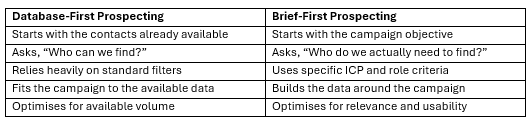
For targeted B2B marketing, brief-first prospecting is a much stronger starting point.
The right prospects do not all exist in one database. Nor do they all maintain complete, current profiles on the same professional network.
Relevant information may sit across company websites, news, public announcements, social media, industry sources, and other credible channels.
One source may confirm a person’s role. Another may provide current company context. Another may help determine whether the account still fits the campaign brief.
Multi-source prospect research brings those signals together. It can help marketing teams:
This does not mean collecting every possible piece of information. The purpose is to build enough confidence to answer one simple question:
Is this contact worth activating?
For targeted B2B campaigns, that question matters more than how many names appear in the spreadsheet.
Building accurate prospect lists does not mean returning to slow, entirely manual research.
Automation and AI are essential for processing information at speed. Automation can help collect and structure data. AI can help identify patterns, enrich records, and surface potential matches. But neither can fully understand the context of every campaign brief.
A title may look relevant but have the wrong responsibility. Two sources may contain conflicting information. A company may fit standard firmographic filters but fail a more specific targeting requirement.
This is where human judgement matters. The strongest B2B prospect list building processes use technology for speed and trained people for decisions that require context.
It is not AI versus humans. It is a finely tuned mix:
The goal is not to produce the maximum number of contacts. It is to produce the right contacts efficiently.
For years, B2B prospecting operated like a volume equation.
Build a large database. Send more campaigns. Generate more activity. Wait for a small percentage to convert.
That model becomes harder to justify when marketing teams are expected to protect deliverability, control acquisition costs, improve sales alignment, and demonstrate clearer links between activity and revenue.
Modern B2B marketing needs a different question.
Not: How many people can we reach?
But: How many of the right people can we reach with confidence?
That shift changes the value of prospect data. A massive database may create the potential for more activity. A smaller, accurate prospect list creates the potential for better activity.
Better segmentation. More relevant messaging. Cleaner campaign data. Stronger sales follow-up. Less waste. And ultimately, a clearer understanding of what is actually working.
The largest database does not automatically create the largest opportunity. What matters is whether the data reflects the audience your campaign actually needs.
That means moving beyond static, pre-built contact pools and towards B2B prospect data that is researched around a specific brief, collected from multiple sources, validated for accuracy, and prepared for activation.
At Merit Data & Technology, our database size is zero. Rather than selling contacts from a pre-existing database, prospect lists are researched live and built specifically around each client brief. Contacts are gathered from multiple sources – including beyond LinkedIn – to help create a more comprehensive view of the target audience.
The approach combines the speed of automation, the capabilities of AI, and the flexibility of trained human expertise. Contact data is cleaned with marketing teams in mind, while proprietary four-layer email bounce checks help teams activate their data with greater confidence.
The result is not the biggest possible spreadsheet. It is accurate, campaign-ready B2B contact data built around the people you actually need to reach. Because the real competitive advantage is not having access to more contacts. It is having access to the right contacts your competitors may have missed.

