
Stale B2B contact data is more than an operational issue - it directly impacts marketing performance, sales productivity, and revenue. As contact databases rapidly decay, businesses face higher email bounce rates, poor deliverability, inaccurate reporting, wasted marketing spend, and weaker sales and marketing alignment. This article explains the hidden costs of outdated data, why one-off database cleansing is no longer enough, and how a live, multi-source, continuously validated approach to contact data helps organisations improve campaign performance, maintain compliance, and build a stronger pipeline in 2026.
Most B2B marketing teams know stale data is a problem. Far fewer realise just how much it's costing them. Not just in bounced emails or wasted send credits - though those are real enough.
The deeper costs are harder to see: campaigns that look like they underperformed when the data was the problem all along. Sales reps burning hours on leads that went nowhere. Marketing and sales blaming each other when the real culprit was sitting quietly in the CRM. Reporting that can't be trusted because the contacts underneath it were out of date before the campaign even launched.
Stale B2B contact data doesn't send you an invoice. It just quietly drains your budget, your pipeline, and eventually - your team's confidence in each other.
This piece breaks down where those costs actually show up, why the usual fixes don't work, and what genuinely fresh contact data looks like in 2026.
Faster than most teams realise.
According to Marketing Sherpa research, B2B contact databases decay at around 2.1% per month, roughly 22.5% per year. Some sources put it higher: in high-turnover industries like technology, annual decay rates can reach 30% or more. Email addresses specifically decay at 23-30% annually. Phone numbers change at around 18% per year. Job titles shift even faster.
Put simply: if you bought or built a list twelve months ago and haven't refreshed it, roughly one in four contacts is already out of date. On a list of 10,000 records, that's 2,500 people you're reaching at the wrong email address, with the wrong title, or at a company they've since left. And it compounds. A list cleaned eighteen months ago and left untouched isn't just 25% stale - it's quietly decaying every single week.
The numbers behind this are stark. Gartner research puts the average annual cost of poor data quality at $12.9 million per organisation. IBM research estimates bad data costs U.S. businesses $3.1 trillion per year in aggregate.
Companies lose an average of 15% of revenue to inaccurate data - through wasted marketing spend, failed outreach, and missed pipeline. These aren't abstract figures. They show up in your campaigns.
Here's where.
Your email deliverability takes a hit - and doesn't recover quickly
This is usually where teams first notice something is wrong. Invalid or inactive email addresses trigger hard bounces. Hard bounces signal poor sending behaviour to ISPs and mail servers. Once your bounce rate climbs above roughly 2-3%, your domain reputation starts to degrade - and when that happens, even your valid emails start landing in spam.
The knock-on effect is significant. Research suggests bounce rates above 10% can cut email-influenced revenue by 3-50% and reduce overall deliverability by 15% or more. That means your whole programme suffers, not just the sends to stale records.
What makes this particularly costly is the lag. Most teams don't notice the damage until it's already embedded. By then, the stale records responsible have often been in circulation for months.
Every email sent to a bad address is wasted. Every sequence run against an outdated job title misses the actual buyer. Every hour your SDR spends chasing a lead who changed roles six months ago is time not spent on something real.
Research from Salesforce found that sales reps spend only 28% of their time actually selling. Bad data makes that already-small window even smaller. Sales reps lose an estimated 500 hours - around 62 working days - per year to validating and correcting contact information. That's nearly a quarter of their selling capacity gone.
For marketing teams, the math is just as painful. If your database is running at 50% accuracy (the industry average, according to independent testing), and that data is decaying at 22.5% annually, you're constantly running campaigns on a foundation that's eroding beneath you.
This is the hidden cost most teams miss entirely.
If 30% of your target account contacts are outdated, you're systematically missing 30% of your addressable market. But here's the more insidious version: you don't know which 30%.
So the accounts with the freshest data get the most outreach - not necessarily the accounts with the best fit. Your targeting starts drifting away from your actual ICP, and because the drift is gradual, it takes a while to surface in the numbers.
By the time you've noticed your open rates are down, your pipeline is lean, and your ABM programme isn't converting, the root cause is often data quality - not messaging, not channel, not timing.
This is where data quality becomes a relationship problem.
Marketing qualifies contacts based on outdated roles. Sales follows up and finds the person has moved on, been promoted, or is no longer in a buying function. Sales loses confidence in marketing-generated lists. Marketing defends the leads. The conversation gets political.
None of that happens because either team is wrong. It happens because the shared data underpinning the handoff was never accurate in the first place.
Once that trust erodes, it's slow to rebuild - and the data quality issue quietly becomes a go-to-market problem.
If the contacts in your database are wrong, your campaign data is wrong too. Opens, clicks, and conversions can't be reliably attributed to the right audience segments. Low open rates might not reflect weak subject lines - they might reflect a list where a quarter of the addresses no longer exist.
The consequence is that teams make strategic decisions - about budget allocation, channel mix, messaging - based on data that doesn't accurately reflect reality. Investment gets misdirected. Experiments fail to produce learnings. Optimisation cycles spin without improving anything.
Bad data doesn't just hurt performance. It breaks your ability to understand what's driving performance.
Stale data isn't only an accuracy problem. It's a compliance problem.
Outdated records may include contacts who have withdrawn consent, moved jurisdiction, or whose data should no longer be held under GDPR and equivalent frameworks in the UK and EU. Using or storing those records without review creates legal and reputational exposure that's harder to quantify - but very real.
In 2026, with privacy regulation tightening across major markets, treating data hygiene as a compliance function is no longer optional.
The standard response to stale data is a one-off clean. Pull the list, remove obvious errors, de-duplicate, refresh a few fields, and move on.
This helps. But it doesn't fix the underlying problem. B2B data decays continuously. A database you cleaned in January is already degrading in February. By the time the next quarterly or annual clean arrives, the problem has rebuilt itself - and in fast-moving sectors like technology and financial services, significant decay can happen within a single campaign cycle.
"Updated quarterly" sounds reassuring until you understand that 6 - 9% of records go stale between those updates. Real-time verification catches decay as it happens. Batch processes applied once every few months don't.
The teams managing data quality most effectively have stopped thinking about data hygiene as a periodic event. They've moved to models where contact intelligence is continuously refreshed - treated as a live asset, not a file that gets cleaned every so often.
The structural alternative to a stale database isn't a better-maintained database. It's a different sourcing model entirely.
Instead of drawing from a pool of records collected months or years ago, contacts are researched and assembled live - built specifically for each brief, from multiple validated sources, at the point they're needed.
This is the core difference between working from a static database and working from real-time contact intelligence. The former is always decaying. The latter reflects the market as it actually exists today.
In practice, a multi-source live model draws on company websites and current team pages, news and press releases that surface leadership changes, social signals beyond LinkedIn (capturing contacts who don't maintain up-to-date profiles), and firmographic sources that validate company structure, size, and subsidiaries.
The result is a list that's accurate to now - not to when a vendor last scraped LinkedIn.
To completely insulate your pipeline from the costs of data decay, high-performing B2B organizations are stepping away from the "big database" model entirely.
Achieving a high-impact, campaign-ready data layer requires an intentional shift in how lists are built and maintained:
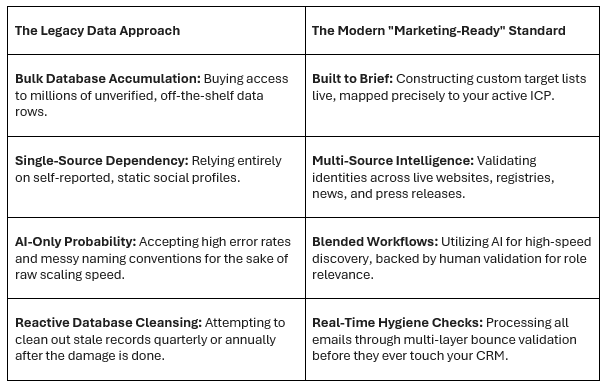
AI and automation have made it possible to assemble contact data faster than ever. That's genuinely useful.
But speed doesn't equal accuracy, and in B2B outreach, accuracy is what determines whether a campaign actually performs. Automated systems are built on pattern recognition. They handle volume and enrichment well. They struggle with nuance - matrix organisations, interim roles, shared mandates, buying committees where influence doesn't follow job titles. These are exactly the subtleties that determine whether a contact is the right person or a wasted send.
Human validation - applied to the fields that actually drive campaign outcomes - is what converts raw data signals into contact records your team can activate with confidence. It confirms role relevance, validates seniority, and catches the records that should never have made the list in the first place.
Neither automation alone nor human-only research is the answer. The model that consistently outperforms combines both: automation for speed and coverage, human expertise for accuracy and trust.
When teams work from contact data that is genuinely current, built to brief, and validated before it reaches the CRM, the impact shows up quickly:
Bounce rates drop, sender reputation is protected, and email programmes stop eroding their own deliverability. Segmentation reflects actual buying committees - not who was in a role twelve months ago. Sales handoffs improve because the contacts marketing passes over are real, current, and correctly titled.
CRM environments stay cleaner, with fewer duplicates and fewer fields that need correcting before a sequence can launch. And campaign reporting actually means something, because the data underpinning it is accurate.
More importantly, teams stop second-guessing their lists. The energy that used to go into questioning data quality gets redirected into the work that actually drives pipeline.
It is.
The Gartner figures, the IBM research, the decay benchmarks - they all point in the same direction. Outdated B2B contact data is one of the most consistently underestimated costs in marketing.
The real question is whether your team is building its go-to-market strategy on a foundation that holds up - or one that's quietly eroding while you're focused elsewhere.
In 2026, the difference between a list that was accurate last year and a list built live for today's brief isn't a minor detail. It's a competitive gap. The teams winning on outreach aren't necessarily the ones with better messaging or bigger budgets. They're the ones working from data their competition simply doesn't have access to.
Artificial intelligence has transformed how marketing data is collected and enriched.
Automation makes it possible to process enormous volumes of information quickly and efficiently.
But speed alone doesn't guarantee accuracy. AI is excellent at identifying patterns and gathering information at scale.
It is less effective at understanding organisational nuance-such as buying authority, regional decision-making, matrix reporting structures, or the subtle differences between similar job titles. That's why the highest-performing marketing data combines the strengths of automation with human validation.
Automation provides scale. Human expertise provides context. Together, they produce contact data that marketing and sales teams can trust.
As B2B marketing becomes increasingly data-driven, stale contact data is quietly becoming one of the biggest barriers to campaign success. It impacts everything from email deliverability and audience targeting to reporting accuracy, sales productivity, and revenue growth.
Leading organisations are moving away from static databases and adopting a more intelligent approach-one built on continuously refreshed, validated, multi-source marketing data that's ready for activation. That's the approach Merit Data & Technology takes.
Merit Data & Technology builds B2B contact data differently.
No static databases. No recycled LinkedIn extracts. Every list is researched live, from multiple validated sources, built specifically to your brief - so your team can market with accuracy, compliance, and full confidence from day one.
Rather than maintaining a pre-built database, every contact is researched live against your campaign brief, validated across multiple trusted sources, and strengthened through a combination of automation, AI, and experienced human researchers.
The result is accurate, compliant, CRM-ready marketing data that helps your marketing and sales teams launch campaigns with confidence, protect deliverability, and connect with the people who matter most. Because in modern B2B marketing, your campaigns are only as strong as the data behind them.

