Beyond Scraping: Licensed & API-Based Data Ingestion for Sustainable, AI-Ready Data Platforms
Enterprises must move beyond fragile scraping toward licensed datasets, official APIs, and BYOD ingestion to build compliant, scalable, AI-ready data platforms focused on governance, enrichment, and long-term sustainability.
Why “Beyond Scraping” Is Not Just a Buzzphrase
For the last decade, web scraping has been the engineering shortcut for rapidly acquiring external signals prices, profiles, listings, and domain-specific indicators. It delivers speed, but also fragility and risk: HTML changes, CAPTCHAs, dynamic client-side rendering, and access controls quickly break scrapers. More importantly for regulated enterprises, scraping severs the chain of custody: when you ingest data by scraping, you rarely capture the legal provenance or contractual entitlement required to justify downstream uses such as fine-tuning models or creating RAG embeddings.
Modern data protection and AI governance regimes (GDPR, CCPA, regional AI Acts) treat not just the content of data but its provenance, consent status, and permitted uses as first-class requirements. The real audit failures we see in AI platforms are rarely due to poor model accuracy; they typically occur because teams cannot demonstrate upstream provenance - who provided the data, under what contract, with what usage rights, and whether any deletion or consent obligations were attached. Without that evidence, an otherwise well-performing model becomes a compliance and legal liability.
This is why the strategic shift from opportunistic scraping to contract-backed acquisition is essential:
Scraping: Fast but provenance-poor. Data arrives without verifiable contractual metadata, consent records, or usage constraints; lineage is implicit or missing.
Official APIs: Contracted access with embedded metadata (client IDs, request logs, versioned schemas) that can be recorded as provenance events..
Licensed datasets: Bundled with legal metadata (license text, allowed purposes, expiration, geographic limits) that map directly to policy enforcement.
BYOD: Source-controlled uploads where provenance is explicit (uploader identity, submission timestamp, agreed schema, ingestion agreement).
Operationally and architecturally, this means treating upstream lineage and provenance as part of the ingestion contract, not a reporting add-on. Practically useful provenance captures include:
Source identity (provider, endpoint, dataset id)
Contract reference and license terms (allowed uses, expiry, geographic scope)
Original artifact fingerprint (file checksum, API response hash)
Consent or entitlement proof (consent tokens, signed agreements, purchase receipts)
Retention and deletion instructions (mapped to retention policies)
When these provenance attributes are recorded at ingestion and propagated through transformation and feature pipelines, auditors can answer the critical questions: Was this dataset licensed for model training? Did the provider permit redistribution? Has any subject exercised a deletion or opt-out that requires remediating downstream models or embeddings? If you rely on scraping, the answers to these questions are, at best, partial; at worst, absent.
Architectural consequence: build an ingestion control plane that emits provenance-rich metadata with every object moving into the lakehouse. Store provenance alongside raw artifacts (not as a separate, disconnected log), and tether policy enforcement to that metadata so downstream consumers (ML training jobs, RAG indexers) can enforce usage constraints at runtime. This approach turns data acquisition into a defensible, auditable process and prevents technically successful but legally indefensible models.
Legal Reality Check: Scraping vs Official Access
Web scraping of purely factual, non-personal, public data (e.g., prices, store hours) can still be legal in many jurisdictions when you avoid bypassing authentication and respect applicable laws. However, the moment data can reasonably identify a person; names, emails, IPs, job titles paired with employers: GDPR and similar regulations apply, regardless of how “public” the page looks.
Key points relevant to enterprise architects:
GDPR compliance hinges on a lawful basis for processing (Article 6) and transparency to data subjects (Article 14) when personal data were not obtained directly from them. Article 6 requires organizations to document which lawful basis (consent, contract, legal obligation, vital interests, public task, or legitimate interests) justifies processing; Article 14 requires providing specified information to data subjects when personal data are collected from third-party sources rather than the subject themselves. These are not optional audit artifacts they are legal obligations you must be able to demonstrate in an audit.
Scraping publicly available personal data almost always breaks the Article 14 requirement in practice. When you scrape a website that publishes personal data (names, contact details, job titles, etc.), you become a downstream controller or processor who must notify the data subject about the source, purposes, retention, and legal basis for processing, and provide other Article 14 disclosures. In many operational setups, scraped data is ingested without provenance metadata, consent tokens, or contractual entitlements, so you cannot reliably produce the Article 14 notice trail or evidence of an Article 6 lawful basis. That absence is a frequent root cause of compliance failures in AI projects.
By contrast, API-based and licensed access models provide an auditable chain for Article 6 and Article 14 obligations:
Official APIs and licensed datasets typically come with contractual terms that document permitted uses, jurisdictional restrictions, and data handling obligations. Those contracts become the contractual/legal basis that can support Article 6 (contract or legitimate interest) where applicable.
Licensed data providers and partners can include or provide the provenance metadata and consent records required to satisfy Article 14 disclosures or to demonstrate that appropriate notice and lawful basis checks were performed upstream.
BYOD models allow explicit uploader identity and contractual acceptance of processing terms, which lets you map provenance and notification responsibilities clearly between parties.
Operational implication for architects: ensure every ingestion pipeline captures Article 6 and Article 14 relevant metadata at source and in the provenance record:
Source type and source contact (API provider, dataset vendor, uploader identity)
Evidence of consent or entitlement (consent token, signed agreement, purchase receipt)
Timestamped ingestion event and original artifact fingerprint (for audit and possible erasure)
Retention/deletion policy pointer derived from contract or consent
Technical enforcement: couple the provenance metadata to runtime policy checks so that ML training jobs, RAG indexers, and downstream APIs validate usage rights before consuming data. This converts legal obligations into enforceable runtime gates and materially reduces audit risk.
Architecturally, this allows you to design for compliance rather than bolt it on as an afterthought.
Sustainable Data Acquisition: Core Principles
When you reposition your ingestion strategy around official APIs, licensed datasets, and BYOD, a few principles should anchor your design:
Contractual clarity over technical loopholes. Every external data feed API, licensed corpus, BYOD upload maps to a contract or policy, not a “we hope they don’t notice” scraper.
Governance-first design. Data cataloging, lineage, retention, and access control are first-class citizens in ingestion architecture, not auxiliary features.
Enrichment, not hoarding. The value of ingested data is realized through linking and standardization, not raw volume. Integrate ingestion with MDM and canonical data models so external feeds resolve to golden entities via deterministic and probabilistic entity matching and ontology mapping; persist source links and provenance so curated data products remain consistent, auditable, and suitable for ML and RAG.
Scalability and resilience. Ingestion is implemented with retry, backoff, circuit breakers, idempotency, and observability leveraging message queues and stream processors rather than monolithic cron jobs.
In the next part, we’ll turn these principles into concrete architecture patterns for API-based ingestion.
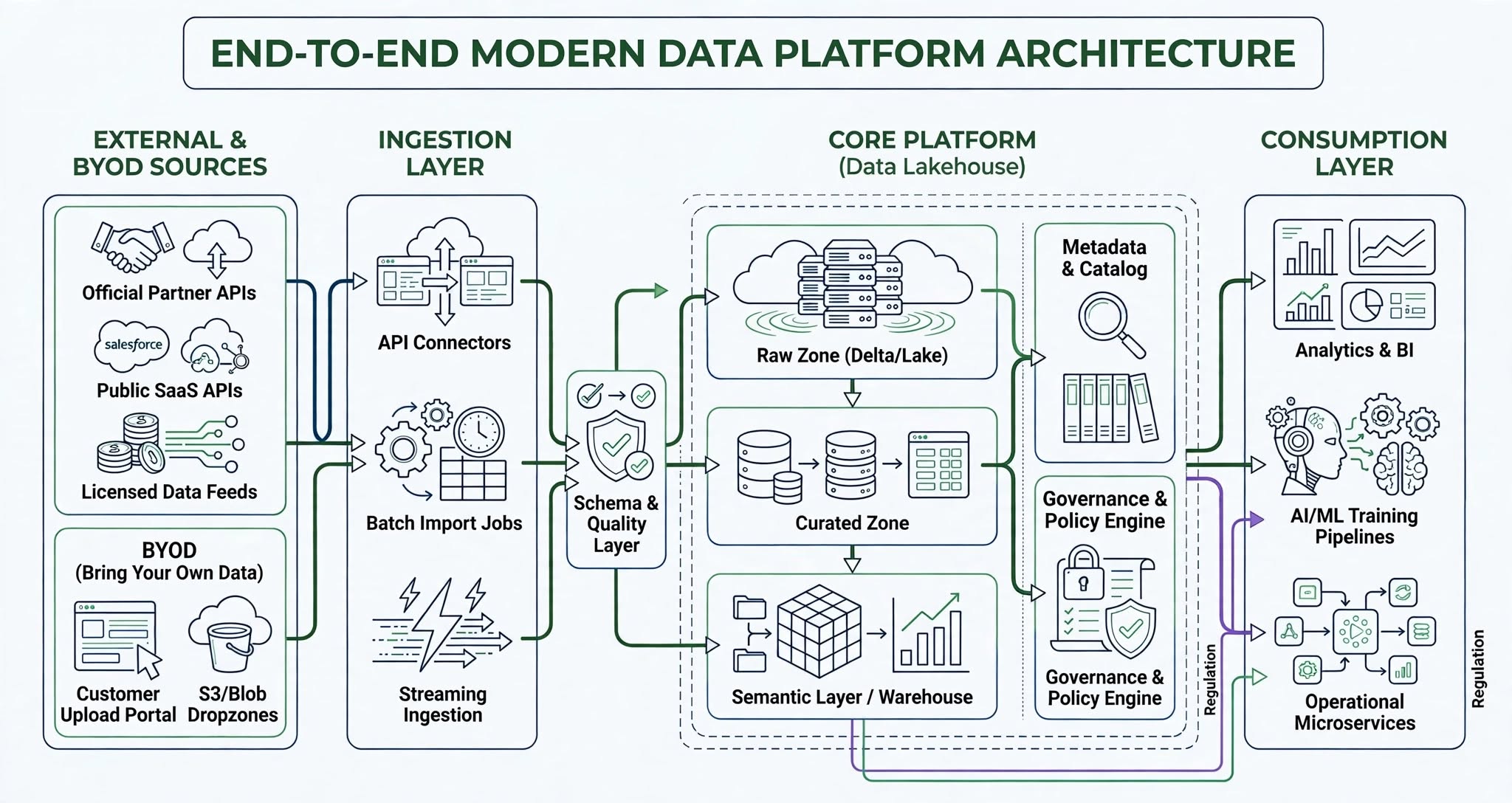
Reference Architecture: Sustainable Data Acquisition Platform
A high-level conceptual view helps position official APIs, licensed feeds, and BYOD within the broader data platform:
This architecture enforces a clear separation between acquisition, storage, governance, and consumption, allowing independent evolution of each layer while preserving lineage and policy control.