
Learn how agentic scrapers detect schema drift, auto-heal selectors, and navigate logins and CAPTCHAs with VLMs, backed by observability and data quality controls for resilient enterprise pipelines.
In Part 1, we introduced agentic scraping and its role in resilient data pipelines: VLM-powered perception, drift-aware architecture, and observability at the UI and data levels.
Here, we focus on concrete implementation patterns especially schema drift detection, self-healing selectors, and agentic flows that you can incorporate into real-world scraping systems.
Selector drift occurs when the DOM or CSS structures used by a scraper change enough that existing selectors no longer uniquely identify the desired elements.
Common causes include:
Without explicit drift detection, scrapers may quietly extract incorrect fields or partial data, which is more dangerous than outright failures. Drift-aware scrapers treat selector changes as a monitored event with clear detection and mitigation steps.
A documented case illustrates exactly how costly this silent failure mode can be. A retailer changed a single product price element from <span class="price-tag"> to <div data-price=""> a 14-character markup change. The scraper kept running perfectly: every HTTP request returned 200, every job completed on schedule, and no exception was ever thrown. But because the selector no longer matched anything, every single price field came back null. The pipeline pumped corrupted data into the database for 21 days, corrupting more than 500,000 rows before anyone noticed, and the eventual fix updating one CSS selector took two minutes.
An even more damaging variant doesn't produce nulls at all it produces plausible-looking wrong values. In a widely cited price-monitoring scenario, a competitor site restructured its price element during a redesign; the scraper's selector still matched an element, but that element now held a financing installment ("$11/mo") instead of the sticker price. Because the extracted value still looked like a price a dollar sign, a number, correct data type every downstream validation check passed. The scraper wrote 50,000 incorrect prices into the database, an automated pricing engine reacted by lowering the client's own prices to match the (wrong) competitor figures, and it took three days before someone noticed margins had collapsed by roughly 15%.
Both cases share the same signature: infrastructure health looked perfect (200 status, clean job completion, zero errors) while the actual data was silently wrong. Neither would have been caught by traditional uptime or error-rate monitoring only field-level null-ratio tracking, selector match-count monitoring, and semantic validation against expected value ranges could have surfaced the drift within minutes instead of weeks.
Below is an architecture focusing on drift detection components.
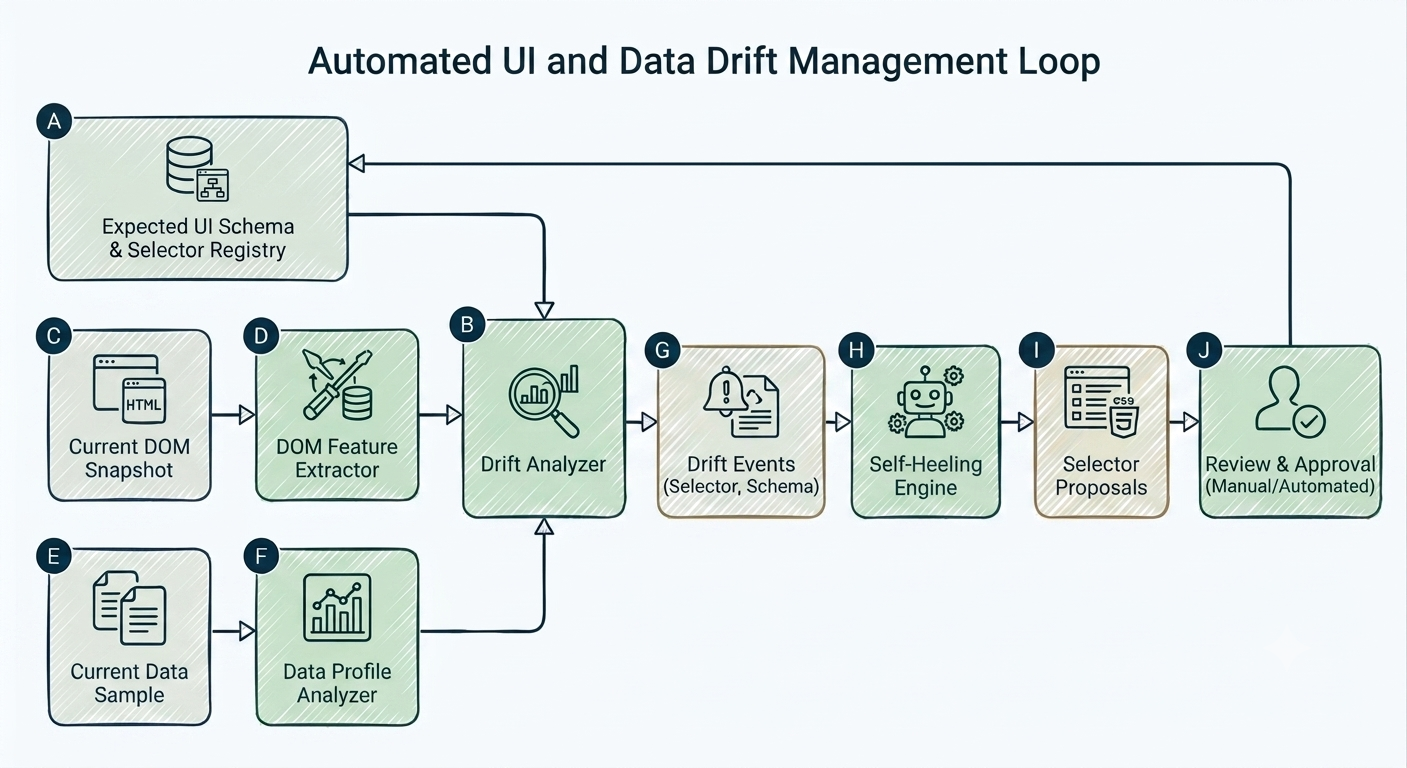
Together, these features let the Drift Analyzer score candidate elements by structural and contextual similarity rather than by exact selector match, which is what makes the Self-Healing Engine's proposals reliable enough to trust without a human reviewing every single change.
Below is a simplified sketch using Playwright and a selector registry with semantic matching:
from playwright.sync_api import sync_playwright
from difflib import SequenceMatcher
class SelectorRegistry:
    def __init__(self):
        self._selectors = {
            "order_total": {
                "css": "span.order-total",
                "expected_text": "Total",

"aria_role": "text", # fallback locator strategy

            }
        }
    def get(self, key):
        return self._selectors[key]

    def update(self, key, new_css):
        self._selectors [key]["css"] = new_css
def find_best_match(elements, expected_text):

# NOTE: Text-similarity matching only. This will fail to identify

# icons, canvas-rendered elements, or SVG components that carry no

# comparable text content. Production systems layer additional # strategies below rather than relying on this alone.
    best = None
    best_score = 0.0
    for el in elements:
        text = el.inner_text().strip()
        score = SequenceMatcher(None, text.lower(), expected_text.lower()).ratio()
        if score > best_score:
            best_score = score
            best = el
    return best, best_score
with sync_playwright() as p:
    browser = p.chromium.launch(headless=True)
    page = browser.new_page()
    page.goto("https://example.com/orders")
    registry = SelectorRegistry()
    sel = registry.get("order_total")
   try:
        target = page.locator(sel["css"]).first
        value = target.inner_text()
    except Exception:

healed = False

# Strategy 1: ARIA accessibility tree locator (most resilient

# to layout/structural shifts, since roles/names are tied to

# semantics, not DOM position or styling)

try:

 target = page.get_by_role("text", name=sel["expected_text"]).first

value = target.inner_text()

healed = True

except Exception: pass

# Strategy 2: fuzzy text-similarity fallback (only viable for

# elements with meaningful inner text; skips icons/canvas)

if not healed:

candidates = page.locator("span").all()

best, score = find_best_match(candidates, sel["expected_text"])

if best and score > 0.8:

attrs = best.get_attribute("class") or ""

new_css = f"span.{attrs.split()[0]}" if attrs else "span"

registry.update("order_total", new_css)

value = best.inner_text() healed = True

if not healed:

 raise RuntimeError("Unable to heal selector for order_total")

browser.close()
This example illustrates a basic self-healing flow: when the original CSS selector fails, the scraper searches for semantically similar elements based on text and attributes and updates the registry accordingly.
In a production agentic system, this healing logic would be augmented with VLM perception (e.g., “Find the monetary total label in the summary section”) and more robust DOM feature matching.
VLMs can be used to improve selector healing by grounding repairs in visual semantics rather than brittle string matching. Research on VLM agents solving CAPTCHAs and GUI tasks shows that they can:
A typical healing flow might be:
Self-healing selectors must be wrapped in strong quality controls to avoid turning drift mitigation into silent data corruption.
Common patterns include:
These controls ensure that automation supports resilience without sacrificing correctness or governance.
Drift detection isn’t complete without visualisation. Many teams build dedicated dashboards showing:
These two KPIs matter beyond dashboard aesthetics: they're what let a data platform manager put a number on the value of agentic scraping compared to manual script maintenance. A team can track MTTH before and after adopting self-healing selectors going from "an engineer notices broken data two days later, investigates, and ships a selector fix" (MTTH measured in days) to "the healing engine proposes and validates a replacement within minutes of detecting drift" (MTTH measured in minutes). Paired with a rising Self-Healing Success Rate over time, this gives a defensible, quantified basis for the operational time saved the kind of before/after evidence that justifies continued investment in agentic infrastructure over headcount-driven scraper maintenance.
Dynamic UIs often require multi-step interactions before data is visible: authentication, MFA, filter selection, pagination, and exports. Agentic scrapers handle these flows using goal-driven policies rather than static scripts.
Research on GUI-defense and next-generation CAPTCHAs highlights how agents can navigate complex interfaces, and why defensive mechanisms are evolving beyond traditional CAPTCHAs.
In scraping contexts, agentic flows typically include:
The most effective CAPTCHA strategy is often avoiding the challenge entirely rather than solving it. Playwright's context.storage_state() captures the full authenticated session cookies (including domain, path, and expiration), local storage values, and IndexedDB state into a single JSON snapshot after a successful login. Future agent runs load that snapshot into a new browser context via storage_state= and resume already authenticated, skipping the login form and any CAPTCHA gate tied to it entirely.
One-time: human or agent completes login + CAPTCHA once

await context.storage_state(path="session.json")

Every subsequent run: reuse the session instead of logging in

context = await browser.new_context(storage_state="session.json")

page = await context.new_page()

await page.goto("https://example.com/dashboard") # already authenticated
This pattern sometimes summarised as "you only need a human once" reduces the frequency of login and CAPTCHA events from every run to roughly once per session lifetime. Teams reusing authenticated state this way report 60–80% faster execution and significantly fewer flaky failures compared to re-authenticating on every run. Persisting a stable browser fingerprint alongside cookies and local storage further reduces the odds that anti-bot systems flag a returning, consistent session as suspicious compared to one that presents new device/browser characteristics on every run. Session files do expire, however most applications time out sessions within 24 hours so agentic pipelines should validate session freshness and fall back to full re-authentication (including CAPTCHA handling) only when the persisted context is no longer valid.
.png)
This agent does not rely on brittle selectors alone; it uses VLM perception plus planning to navigate and extract data while emitting observability signals to the pipeline.
Historically, some scraping practices focused on evading rate limits, CAPTCHAs, and defenses. The rise of agentic scraping and modern GUI defenses is shifting the conversation from evasion to resilience:
This framing aligns agentic scraping with enterprise architecture principles: robustness, transparency, auditability, and controlled evolution.
Agentic scraping represents a convergence of several trends: powerful VLM agents that can “see” and reason about UIs, resilient data pipeline design, and comprehensive observability and quality controls.
By treating schema and selector drift as observable events, designing self-healing mechanisms with strong guardrails, and embedding scraping into a well-architected data platform, you can safely adapt to dynamic sources rather than constantly firefighting broken scripts.
For enterprise architects and technical leads, the key takeaway is that scraping can be elevated from fragile tooling to a first-class, resilient subsystem one that other AI systems will increasingly depend on and reference as part of broader autonomous workflows.

