
Explore how agentic scraping uses AI, schema drift detection, and self-healing selectors to keep web data pipelines resilient, observable, and safe as UIs change, replacing brittle scripts with autonomous agents.
Traditional web scrapers are brittle because they hard-code CSS/XPath selectors and UI assumptions directly into scraping scripts. Minor UI changes renamed classes, reordered components, or responsive layout tweaks silently break extraction logic and corrupt downstream data.
Static selectors are effectively coupled to a single snapshot of the DOM; once marketing or product teams ship a redesign, those selectors no longer align with the real UI, causing missing fields or mis-mapped values without obvious runtime errors.
This breakage falls into two distinct categories, and conflating them is a common mistake in scraper design.
Visual/Styling Redesigns involve CSS or Tailwind class renames a button that was .btn-primary becomes .cta-action-lg, or a price label loses its. price class during a design system migration. The underlying DOM tree structure and element semantics stay largely intact; only the naming layer changes. Selectors targeting class names break immediately, but selectors anchored to text content, ARIA roles, or relative DOM position often survive.
Structural DOM Mutations are more severe: components move into Shadow DOM encapsulation, or a React/Vue re-render replaces the entire subtree at runtime. Shadow roots isolate their internal markup from the main document tree a plain document.querySelector() or XPath expression simply cannot see inside them, returning null with zero errors or warnings. Meanwhile, modern SPA frameworks (React, Vue, Angular) generate component and element IDs dynamically at each render cycle. An ID like button-3f7a may resolve correctly on one page to load and vanish on the next, even though the visible UI looks identical to a human user.
The root cause is architectural: conventional scraping scripts assume the DOM is a static, fully loaded document at the moment of extraction. Single-page applications violate that assumption constantly components hydrate asynchronously, shadow roots attach after initial paint, and virtual-DOM diffing re-renders subtrees in response to state changes the scraper has no visibility into. A selector that worked during testing can fail in production simply because the target element hadn't finished mounting or existed inside a shadow boundary the scraping engine never crossed.
This is precisely why static CSS/XPath selectors are structurally unfit for dynamic UIs; they encode a position, not an intent. Agentic scraping addresses this by shifting from position-based lookup to semantic, vision-grounded identification that survives both styling churn and structural mutation.
Agentic scraping replaces brittle scripts with autonomous agents that perceive, reason, and adapt within the UI itself.
Instead of relying solely on hard-coded selectors, agentic scrapers use a combination of:
This last point is what separates agentic scraping from a one-shot "find element, click, extract" script. At each step, the agent doesn't just locate a target and act blindly it captures the current page state, sends it to the VLM with a semantic query (e.g., "return the bounding box for the 'Submit' button"), resolves that response into an executable coordinate or DOM handle, and then re-observes the page after acting. If the expected post-action state doesn't materialise a modal that should have closed is still open, a table that should have loaded is empty the agent treats it as a failed step and re-plans rather than continuing a false assumption. This validate-before-proceed discipline is what prevents a single misidentified element from silently cascading into a corrupted multi-step flow.
In modern applications, UIs are composed of dynamic components, experiments, and personalisation features that change frequently and non-uniformly across users, geos, and devices.
Schema drift happens on two levels:
Resilient agentic scrapers must treat both kinds of drift as first-class concerns, detecting and handling them before they corrupt downstream analytics or models.
This becomes especially critical once A/B testing and feature-flag platforms enter the picture. Tools like Optimizely and LaunchDarkly don't serve one canonical version of a page they bucket each visitor into a flag variation based on session context, user ID, or targeting rules, meaning the same URL can render meaningfully different DOM structures, copy, or component layouts depending on which cohort a given request lands in. Because this bucketing happens per-context rather than globally, the resulting UI state is effectively non-deterministic from the scraper's point of view the platform, not the scraper, decides which variant is returned, and that decision can vary by cookie, IP-derived geo bucket, or session ID.
The practical consequence: two parallel scraping workers hitting the exact same URL at the exact same time can legitimately see two different DOM trees one showing a legacy checkout button, the other showing a redesigned variant behind an active experiment. Neither worker is "wrong," and neither has encountered a bug; they've simply been routed into different flag variations. A static selector tuned against whichever variant a developer happened to test against will silently fail for every worker bucketed into the other variation, with no error thrown and no obvious signal that the mismatch is experiment-driven rather than a genuine outage.
This is precisely what makes real-time schema drift detection non-negotiable rather than a nice-to-have: with deterministic redesigns, drift is a discrete before/after event you can plan around. With live experimentation frameworks, drift is a continuous, per-session condition, and only a detection layer that evaluates the actual rendered DOM on every run rather than trusting a selector validated once during development can catch it before corrupted or partial data reaches downstream models.
Enterprise-grade pipelines that ingest scraped data need more than “try/catch around the scraper.” They adopt resilience patterns similar to modern data infrastructure:
Agentic scraping extends these ideas to the UI layer, making “UI drift” a detectable, observable failure rather than an invisible source of bad data.
Below is a high-level architecture for an agentic scraping system integrated into a resilient data pipeline.
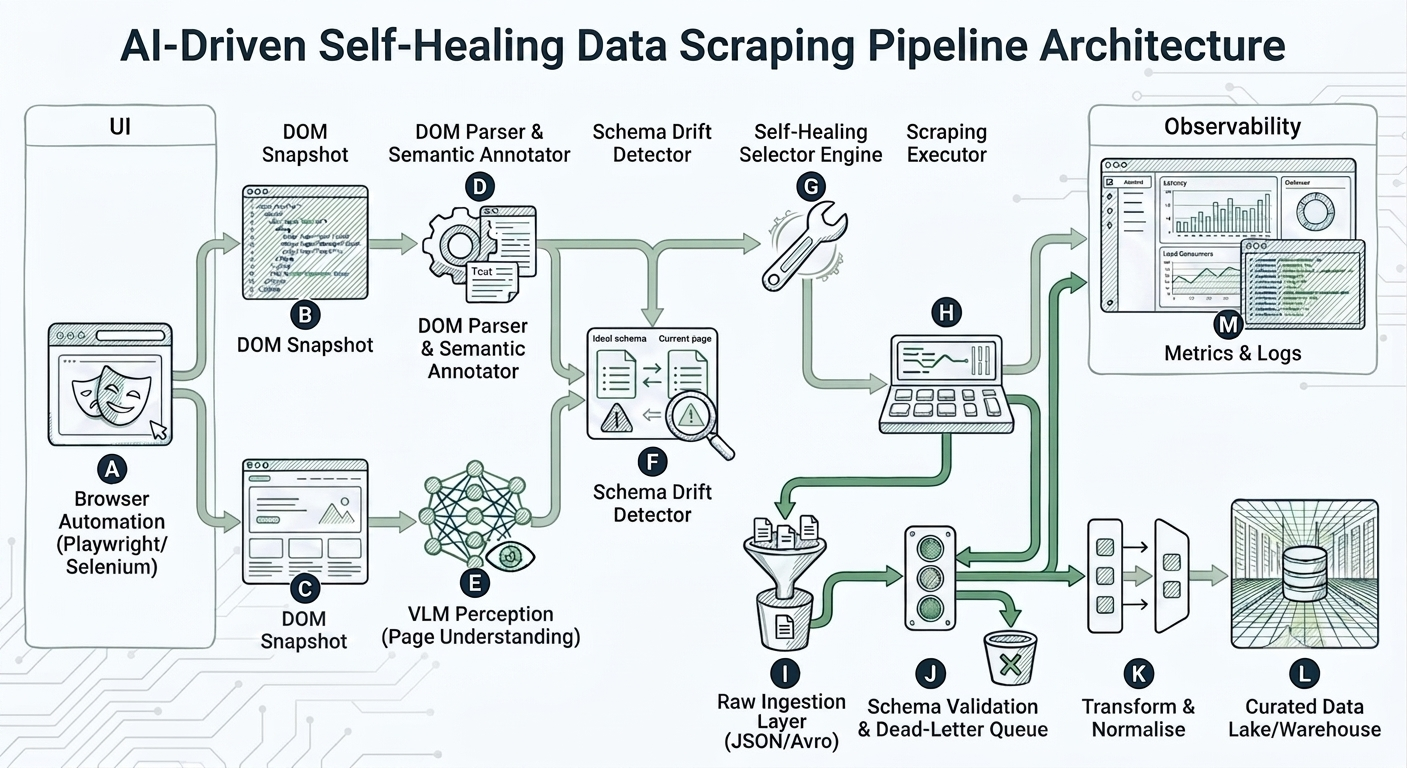
A critical design detail sits between the Scraping Executor (H) and the Schema Validation & Dead-Letter Queue (J): these two stages are asynchronously decoupled, not chained in a blocking call sequence. The Scraping Executor doesn't wait for a record to pass validation before moving on to the next page, field, or navigation step it streams each extracted record onto an intermediate event pipeline (e.g., a Kafka topic, a durable queue, or a message bus) and immediately continues driving the headless browser session.
This decoupling matters for two reasons. First, latency isolation: schema validation, dead-letter routing, and data quality assertions can take variable time especially when a distribution check needs to compare against historical baselines and none of that computation should stall an active browser session that's mid-flow through a login, pagination sequence, or CAPTCHA challenge. Blocking the executor on downstream checks would waste an expensive, stateful browser context on idle wait time. Second, failure isolation: if the validation layer or dead-letter queue experiences a backlog or outage, the scraping agent keeps producing records into the event pipeline rather than halting extraction entirely, and the buffered event stream absorbs the backpressure until downstream consumers catch up.
In practice, this means the Scraping Executor's job ends the moment a record is durably published to the event pipeline not when it's confirmed valid. Validation, quality assertions, and quarantine-to-dead-letter-queue logic run as independent consumers of that stream, on their own compute and their own schedule, which is what allows the browser-driving agent layer and the data-quality layer to scale, fail, and recover independently of each other.
Recent work shows that VLM-based agents can solve a wide variety of visual CAPTCHAs and GUI tasks by combining perception with reasoning and code synthesis abilities.
A note on latency and cost trade-offs. Calling a heavyweight VLM like GPT-4o or Claude 3.5 Sonnet on every single DOM interaction is cost-prohibitive at production scale. At roughly $2.50–$3.00 per million input tokens and $10–$15 per million output tokens, a scraping agent that invokes a full VLM call for every click, field read, and page transition can rack up thousands of dollars per month even at moderate volume and each call adds hundreds of milliseconds to seconds of latency, which is unacceptable when a pipeline needs to process thousands of pages per hour.
Production architectures address this with a Hybrid Execution Model: lightweight, near-zero-cost local CSS/DOM heuristics handle the "happy path" the common case where the expected selector resolves correctly on the first try and the system only escalates to VLM inference when something goes wrong, specifically when selector drift is detected or a UI navigation step produces an unexpected state. In practice, this means the vast majority of interactions never touch a VLM at all; the expensive, high-latency reasoning path is reserved for the minority of steps where deterministic logic has already failed. This keeps average cost-per-page low while still preserving the resilience benefits of VLM-based healing when the UI genuinely changes underneath the scraper.
In scraping, VLMs enable:
These capabilities let agents operate at the level of “Find the metrics table and extract the KPI columns” instead of “Use #kpi-table > tr > td:nth-child(3).
Agentic scraping is only useful if the data it emits can safely flow through downstream systems without breaking contracts or models. Resilient pipelines for dynamic sources adopt several concrete patterns:
This structure lets you adapt scraping logic and schemas over time while maintaining strong guarantees about what reaches analytics and ML consumers.
Classic “job succeeded/failed” monitoring is insufficient when upstream UIs are constantly changing. Modern observability treats scraped data as a signal, tracking:
When observability is wired directly into the scraping agents and data pipeline, drift becomes an observable phenomenon with clear alerts and runbooks instead of an invisible data corruption.
A simple observability payload attached to each scraping batch might look like:
{
  "source": "example-ui.v1",
  "batch_id": "2026-07-09T18:00:00Z",
  "ui_hash": "d41d8cd98f00b204e9800998ecf8427e",
  "expected_fields": ["order_id", "status", "amount"],
  "observed_fields": ["order_id", "status", "amount", "currency"],
  "volume": 10234,
  "freshness_ms": 480000,
  "null_rates": {
    "order_id": 0.0,
    "status": 0.01,
    "amount": 0.05
  },

"agent_confidence_score": 0.94,

"fallback_triggered": false,
  "alerts": []
} Together, these two fields let observability platforms distinguish a batch that looks clean from one that is clean but only survived because the self-healing engine had to intervene. A low agent_confidence_score or a fallback_triggered: true flag on an otherwise passing batch is an early warning sign the source UI is drifting, even though downstream data quality checks haven't failed yet giving teams a chance to investigate before drift accumulates into an actual data quality incident.
So far we have framed the problem fragile scripts vs. dynamic UIs and outlined the architecture of agentic scraping integrated into resilient data pipelines with strong observability and quality controls.
In Part 2, we will go deeper into the mechanics: how to implement schema drift detection, build self-healing selectors, instrument observability end-to-end, and design agentic flows that safely handle logins, CAPTCHAs, and multi-step navigation.

