
Part 1 defines compliant data acquisition, explains regulatory drivers, and introduces a reference architecture for consent-aware, auditable, rate-limited enterprise data harvesting pipelines.
Compliant data acquisition is the disciplined, contract-aware process of collecting data under explicit rights, traceable provenance and robust audit controls, rather than opportunistic “scraping” that ignores legal and operational constraints. It transforms data harvesting into a first-class governance capability that can survive regulator scrutiny, customer due diligence and internal audit reviews.
The stakes extend well beyond the initial collection step. When data enters an enterprise without verifiable provenance, every downstream fine-tuned LLM, vector index, embedding store, recommendation engine or predictive model inherits that uncertainty. If a data subject, copyright holder or regulator later challenges the lawful processing of the underlying data, the organisation may be required to delete, quarantine or retrain affected assets. Because training data can become embedded in model weights, removal may require substantial retraining or, in severe cases, the retirement of an entire foundational model.
This creates downstream model liability: the legal, financial and operational exposure that propagates from a weak acquisition decision into every model, retrieval system and AI product built on that data. It also reinforces a fiduciary obligation on boards, executives and data stewards to exercise reasonable care over data provenance, lawful basis, contractual rights and auditability. AI governance is therefore not merely a technical control; it is part of enterprise risk management and director-level oversight.
This first part focuses on foundations: definitions, regulatory drivers, fiduciary and downstream liability considerations, architectural principles and a high-level reference architecture for compliant data acquisition in AI and analytics programmes. Part 2 will dive into implementation patterns, code examples and practical flows that engineers can implement directly in their stacks.
Compliant data acquisition is not just “collecting data responsibly”; it is a set of verifiable controls over how each data asset is sourced, licensed, transformed and used. In modern AI programmes, it sits alongside model governance as a core assurance layer for boards, regulators and customers.
A foundational control is the Zero-Trust Ingestion Boundary. Data pipelines must not ingest unverified payloads by default. Before records are permitted to enter the bronze or raw lakehouse zone, the ingestion service must cryptographically validate the dataset registration, source identity, payload integrity and active licensing manifest. If the dataset is unregistered, its licence has expired or been revoked, its signature cannot be verified, or its consent and lawful-basis metadata is incomplete, the payload must be rejected or quarantined not silently written to the lakehouse.
At minimum, a compliant acquisition pipeline must be able to demonstrate for each dataset:
Crucially, this evidence must be retrievable “on demand” in an audit-ready form, not reconstructed via emergency spreadsheets when a regulator or customer asks questions.
Multiple regulatory and standards frameworks now explicitly require organisations to track the provenance, consent and lawful basis of data used in AI and analytics. For AI-specific systems, ISO 42001 introduces Annex A controls for “Acquisition of Data” and “Data Provenance” that emphasise lawful, auditable data pipelines.
The EU AI Act raises the bar further for high-risk AI systems. Article 10 imposes strict data governance obligations on the datasets used for training, validation and testing. Organisations must ensure that training data is relevant, sufficiently representative and, to the extent possible, free of errors; examine datasets for likely biases; and implement appropriate mitigation measures before deployment. This makes training-data provenance, source documentation, quality controls and bias-mitigation evidence an immediate concern for enterprise risk committees, not merely a data engineering task.
Article 12 complements these controls through mandatory record-keeping and logging. High-risk AI systems must maintain automatically generated event logs sufficient to trace the system’s functioning and reconstruct material events across its lifecycle. For compliant data acquisition, this means ingestion events, dataset versions, licensing status, consent state, transformation steps, access events and downstream model usage must be captured in tamper-evident, queryable audit records.
ISO 42001 reinforces the same direction. Annex A.7.3 (Acquisition of Data) requires organisations to demonstrate data type and source, legal rights such as consent and licences, provenance documentation and live audit records for each AI dataset. Annex A.7.5 (Data Provenance) calls for continuous, indisputable proof of origin, stewardship, transformation and use across the whole pipeline, including change and access logs.
Privacy laws add further requirements. For example, Quebec’s Law 25 requires organisations to disclose the source of personal information obtained from third parties when individuals ask, which is impossible without robust provenance tracking. Data protection obligations under regimes such as the GDPR also assume organisations can produce consent records, retention rules and evidence of how data subject requests are honoured, again reinforcing the need for rich lineage, consent logging and audit-ready data governance.
From these regulations and standards, four pillars emerge as non-negotiable for compliant data acquisition: consent, contracts, provenance and auditability. A fifth operational pillar rate limiting and resource protection ensures acquisition respects technical constraints and service quality rather than overwhelming source systems.
1. Consent and lawful basis
Every record containing personal or sensitive data must be linked to a documented lawful basis (e.g. explicit consent, contract, legitimate interest), with a retrievable consent record where consent is relied upon. Modern consent management platforms store time, date, user identifier and the specific version of the notice presented, providing audit-ready proof of consent.
2. Contracts and licensing
For third-party, partner or open datasets, organisations need a documented chain of licences and rights to show their entitlement to use the data, especially for AI training and derivative models. Audit-ready setups tie each dataset to a licence agreement, including AI training rights, indemnities and legal sign-off, avoiding “we assumed it was fine” scenarios.
3. Provenance, lineage and consent lineage
Data provenance is the documented history of a dataset: where it was collected, who collected it, under what rights, how it has been transformed and how it has been used. Consent lineage extends this to consent events, forming a tamper-evident chain of consent issuances, modifications and revocations linked to specific data subjects or assets.
Lineage must also work in reverse to support consent propagation and dynamic revocation. When a user withdraws consent or invokes GDPR Article 17, the lineage service must automatically trace the affected data downstream to table partitions, feature store entities, vector embeddings and model training artefacts. It should then trigger automated purging, invalidation or quarantine workflows, while recording an audit trail of every action taken.
This turns consent from a static intake record into an operational control that propagates across the lakehouse, feature store, vector database and AI model lifecycle.
4. Auditability and exportability
Auditability demands read-only logs of ingestion, transformation, annotation, training use, exports and deletion, with roles, timestamps and justifications. Best practice systems can export audit packs per dataset including timeline, consent receipts and change history in both machine-readable formats (JSON/CSV) and human-readable summaries.
5. Rate limits and resource protection
Rate limiting controls the frequency of requests to APIs or services, protecting servers from overload and ensuring fair resource distribution. Ethical acquisition pipelines respect published rate limits, implement exponential backoff on 429 responses and honour robots.txt and Terms of Service rather than trying to bypass protections.
A compliant acquisition capability should be designed as an enterprise platform, not a collection of one-off scripts. At a high level, we can think in terms of five layers: sources, acquisition orchestrators, governance services, storage/processing and consumers.
High-level architecture components
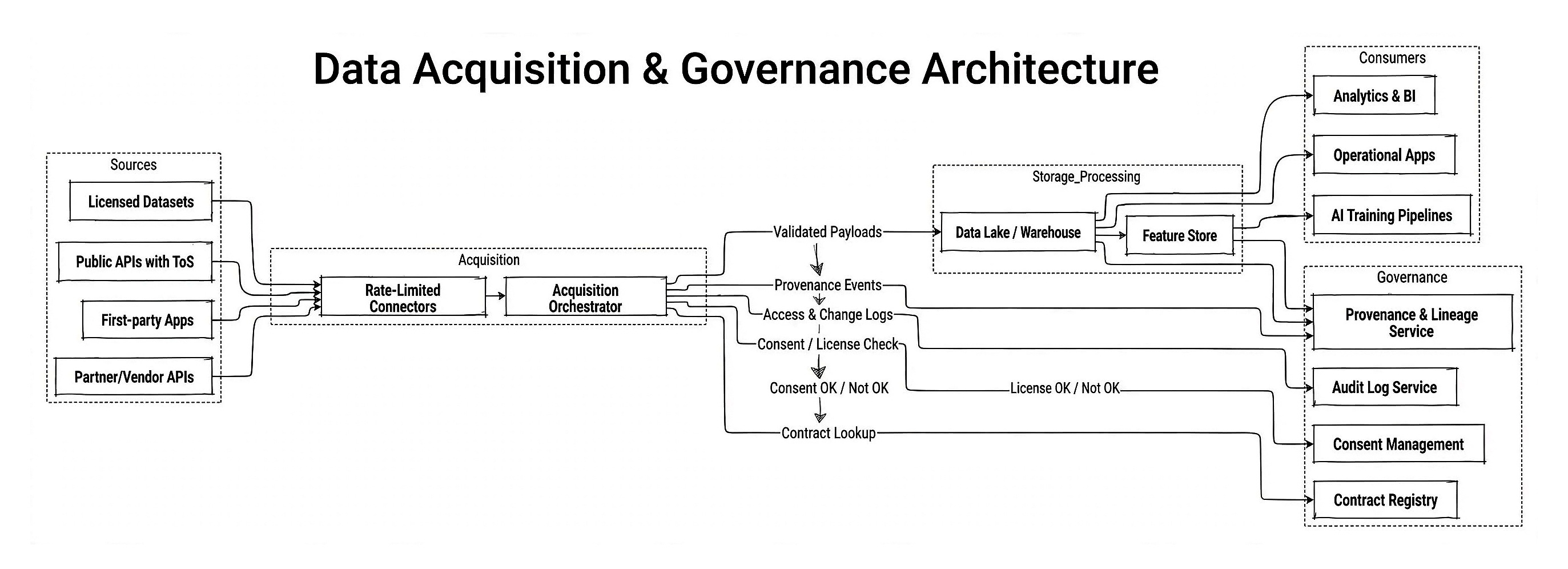
This architecture centralises controls such as consent checks, contract validation and provenance logging rather than leaving them to individual acquisition scripts. It also makes it easier to run “audit fire drills” by mapping every dataset to a named data steward and surfacing evidence from a single provenance service.
A robust data model for compliant acquisition must handle both dataset-level provenance and consent-level lineage. For example, a consent lineage record can be modelled as an append-only chain of consent events, each signed and linked to the previous entry to ensure integrity.
Key entities include:
A cryptographically linked chain of provenance and consent events enables generation of consent provenance reports, which summarise lineage in human-readable and machine-parseable formats for regulatory reporting or principal review.
{

  "event_id": "evt_20260101_123456",

  "event_type": "INGEST",

  "dataset_id": "ds_customer_interactions_v3",

  "source_system": "partner_crm_api",

  "collector_id": "client_app_001",

  "timestamp": "2026-01-01T12:34:56Z",

  "actor": {

    "type": "service_account",

    "id": "svc-acq-crm"

  },

  "legal_basis": {

    "type": "consent",

    "consent_id": "consent_987654321",

    "notice_version": "privacy_notice_v5"

    "jurisdiction": "EU-DE"

  },

  "licence": {

    "licence_id": "lic_partner_crm_2025",

    "jurisdiction": "EU-DE"

    "ai_training_allowed": true

  },

"payload_digest": "sha256:9f2a41c7...",
"prev_hash": "sha256:0f3c21a8...",
"event_hash": "sha256:7d81b3e4..."
}

event_hash = SHA-256(

  canonical_json(payload) +

  canonical_json(legal_basis) +

  canonical_json(licence) +

  prev_hash

) This kind of schema aligns with guidance that provenance and consent evidence should be tamper-evident, linked to licences and exportable in on-demand audit packs. Different environments may back this with blockchain technologies, append-only logs or signed hash chains, but the core principle is preserving chain integrity over time.
From an implementation perspective, acquisition flows should be designed to respect rate limits, ToS and robots.txt directives by default. Instead of trying to “work around” protections, compliant systems treat published limits and policies as constraints to encode in orchestration and scheduling logic.
Common patterns include:
In an enterprise setting, these controls are implemented in shared acquisition libraries or gateway services, ensuring that every data harvesting job automatically respects technical and contractual limits rather than re-implementing logic ad hoc.

This sequence emphasises that consent and contract checks, rate limit enforcement and provenance logging are all first-class stages, not optional “add-ons”.
This first part has defined compliant data acquisition, summarised key regulatory drivers and presented an enterprise reference architecture with governance-centric components. The next part will translate these concepts into concrete implementation patterns and code-level examples, including rate-limited acquisition clients, provenance logging middleware and audit-ready export workflows that can be integrated into modern data and AI stacks.

