
This part explains how to onboard licensed datasets and BYOD feeds, integrate data marketplaces, and design governed data products that legally power AI, analytics, and partner ecosystems at scale.
Parts 1 and 2 established the case for official APIs and described a robust ingestion architecture with queues, lakehouse, and governance. Licensed datasets and BYOD ingestion are the next logical extension: they let you acquire large, curated corpora and partner data via contract-backed channels instead of scraping.
Licensed data marketplaces provide AI-ready training datasets across text, audio, video, image, and code, explicitly designed to eliminate scraping, ad hoc negotiations, and legal ambiguity for AI teams. Enterprise data marketplaces similarly allow internal data producers to publish governed data products for discovery and controlled reuse across business units.
BYOD capabilities: such as “bring your own cost data” in cloud-finops platforms let customers upload structured files into predefined landing zones, which are then integrated and analyzed alongside platform-native data. For an architect, these patterns are structurally similar: external data enters through controlled interfaces, lands in raw zones, and is transformed into governed, enriched data products.
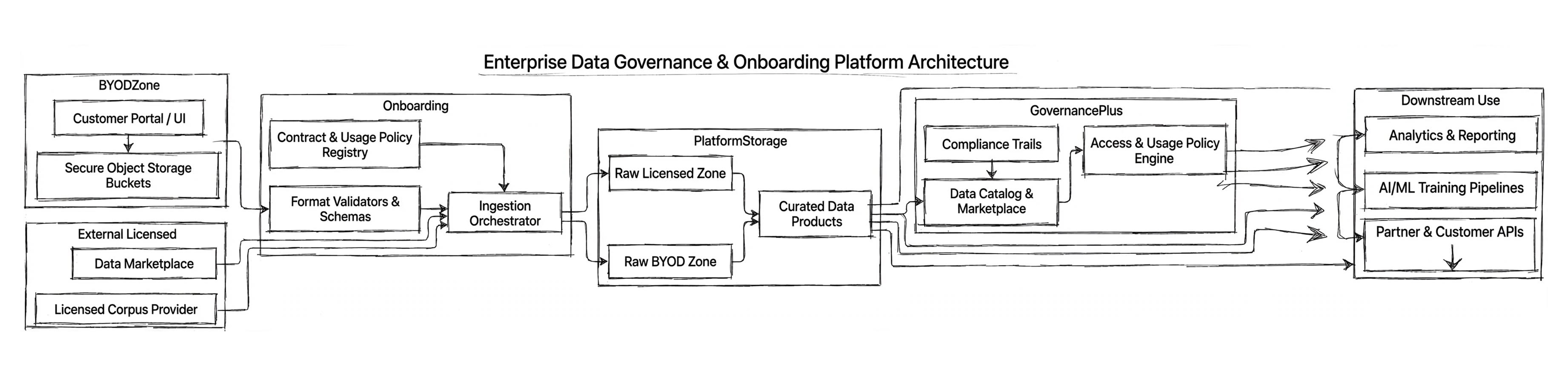
Here:
A common BYOD pattern is: users export data from their systems, upload files to an assigned object storage location (e.g., per-tenant S3 bucket or blob container), and your platform processes them into internal data models.
Example high-level flow:
1. Customer activates “Bring Your Own Data” in the UI, provisioning a dedicated bucket/path and credentials.
2. Customer configures their system to regularly produce files in a prescribed schema (e.g., FOCUS format) and upload them to that bucket.
3. An orchestrator (Airflow/Data Factory/Lambda) watches the bucket for new files, validates them against expected schemas, and ingests them into raw zones.
4. Downstream jobs map and consolidate BYOD data with platform-native data for a unified view.
A simplified Python-oriented orchestrator could look like:
A secure BYOD orchestrator must enforce tenant isolation and storage security before processing any customer-supplied file. Each tenant should use an isolated S3 prefix or bucket with IAM role delegation or tenant-scoped pre-signed S3 URLs, while objects are encrypted using an AWS KMS customer-managed key. Uploads must pass anti-malware and file-sanitization scanning before downstream orchestration validates schemas or triggers ingestion.
import json

import boto3


s3 = boto3.client("s3")

lambda_client = boto3.client("lambda")


QUARANTINE_BUCKET = "platform-quarantine"

CLEAN_BUCKET = "platform-clean"


def upload_tenant_file(tenant_id, file_name, content_type):

    key = f"tenant={tenant_id}/incoming/{file_name}"


    return s3.generate_presigned_url(

        ClientMethod="put_object",

        Params={

            "Bucket": QUARANTINE_BUCKET,

            "Key": key,

            "ContentType": content_type,

            "ServerSideEncryption": "aws:kms",

            "SSEKMSKeyId": "arn:aws:kms:region:account:key/customer-managed-key",

            "Metadata": {

                "tenant-id": tenant_id,

                "scan-status": "pending"

            }

        },

        ExpiresIn=900,

        HttpMethod="PUT"

    )


def process_upload(event, context):

    bucket = event["bucket"]

    key = event["key"]

    tenant_id = event["tenant_id"]


    # Tenant and path validation

    expected_prefix = f"tenant={tenant_id}/incoming/"

    if not key.startswith(expected_prefix):

        raise PermissionError("Tenant isolation violation")


    # Retrieve malware/file-sanitization result

    scan_result = get_scan_result(bucket, key)


    if scan_result != "clean":

        move_to_quarantine(bucket, key)

        raise ValueError("File rejected by security scanning")


    # Copy only clean files into the ingestion-controlled zone

    s3.copy_object(

        CopySource={"Bucket": bucket, "Key": key},

        Bucket=CLEAN_BUCKET,

        Key=f"tenant={tenant_id}/ready/{key.split('/')[-1]}",

        ServerSideEncryption="aws:kms",

        SSEKMSKeyId="arn:aws:kms:region:account:key/customer-managed-key",

        MetadataDirective="REPLACE",

        Metadata={

            "tenant-id": tenant_id,

            "scan-status": "clean"

        }

    )


    # Trigger schema validation and downstream ingestion

    lambda_client.invoke(

        FunctionName="validate-and-ingest",

        InvocationType="Event",

        Payload=json.dumps({

            "tenant_id": tenant_id,

            "bucket": CLEAN_BUCKET,

            "key": f"tenant={tenant_id}/ready/{key.split('/')[-1]}"

        }).encode()

    )
The production implementation should also enforce bucket policies that deny unencrypted uploads, restrict access to tenant-scoped IAM roles, prevent cross-tenant object access, validate object size and file type, and retain scan results and audit events as provenance metadata. Only files marked clean should move from quarantine storage into the ingestion-controlled zone.
Licensed data marketplaces such as those built for AI training provide curated datasets from verified providers, with legal guarantees and usage rights explicitly designed for AI and analytics workloads. Integrating such marketplaces into your platform architecture involves:
Each product should include a defined schema, ownership, refresh frequency, quality metrics, lineage, license restrictions, and supported join keys. This turns licensed data from an isolated file into a governed semantic asset that can be used consistently across analytics, feature engineering, reporting, and AI workloads.
This approach is fundamentally different from scraping: instead of reverse-engineering HTML and hoping fair use applies, you intentionally acquire rights to use data for specific purposes, and your platform enforces those rights technically.
An Enterprise Data Marketplace provides an e-commerce-like interface where data producers publish governed data products and consumers discover and request access. When integrated with your ingestion and governance layers:
This marketplace sits above the lakehouse and ingestion pipelines; it doesn’t replace them but exposes their output in a consumable, governed way.
To make “Beyond Scraping” a reality rather than a slogan, you need not only architecture but also an operating model:
Scraping will still exist for narrow, low-risk scenarios (e.g., monitoring non-personal prices where official APIs are unavailable), but it becomes the exception, not the foundation of your data strategy. For AI-ready enterprises, sustainable data acquisition means building around:
When you design your platform this way, you stop playing HTML whack-a-mole and start operating a legally sound, scalable, and enrichment-focused data ecosystem that can power AI, analytics, and digital products for years to come.

